Animal Guides / Reptiles and amphibians
King cobra
The world's longest venomous snake eats mostly other snakes, builds a nest for its eggs and can raise a third of its body off the ground.
Quick facts
| Fact | Detail |
|---|---|
| Scientific name | Ophiophagus hannah (a 2024 study proposed splitting it into four species) |
| Class | Reptilia (reptiles) |
| Diet | Mainly other snakes, including venomous ones; sometimes monitor lizards |
| Size | Commonly 3 to 4 m; the longest recorded reached around 5.5 to 5.8 m |
| Lifespan | Around 20 years |
| Range | India and Bangladesh through southern China and Southeast Asia to the Philippines and Indonesia |
| IUCN status | Vulnerable |
Habitat
King cobras live in forests, from dense rainforest and bamboo thickets to mangroves and wooded hills, often near streams. They also turn up in plantations and farmland at forest edges, which brings them into contact with people. They are good climbers and strong swimmers.
Behavior
The scientific genus name Ophiophagus means "snake eater," and that is the king cobra's specialty. It hunts rat snakes, pythons, kraits and even other cobras, tracking them by scent with its flicking tongue. It may eat a large meal and then fast for weeks.
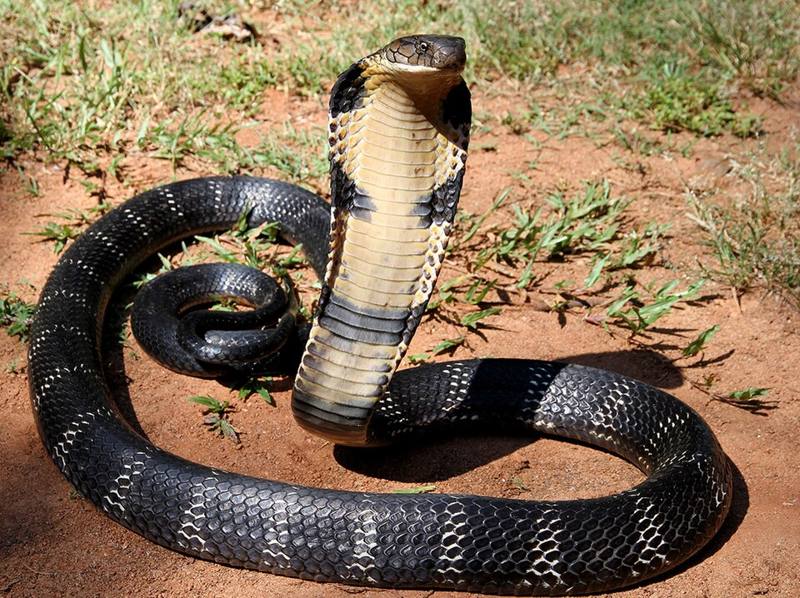
When threatened, a king cobra raises the front part of its body high off the ground, spreads a narrow hood and makes a deep, rumbling hiss sometimes described as a growl. A large king cobra can look an adult person roughly in the eye. Most of the time, however, king cobras avoid people and retreat if given space.
King cobras are the only snakes known to build nests. The female gathers leaf litter into a mound using her body, lays her eggs inside, and often guards the nest until shortly before the eggs hatch. The hatchlings are already venomous.
Venom
King cobra venom is mainly neurotoxic, meaning it attacks the nervous system and can cause paralysis and breathing failure. Drop for drop, it is not the most toxic snake venom, but a king cobra can deliver a very large amount in a single bite. Bites to people are relatively uncommon, and antivenom exists, but a serious bite is a medical emergency.
Splitting the king
In 2024, researchers published a study arguing that what was called one king cobra species is actually four, based on DNA and differences in scale patterns and bands:
| Proposed species | General area |
|---|---|
| Northern king cobra | Northern and eastern India to China and northern Southeast Asia |
| Western Ghats king cobra | Western Ghats of India |
| Sunda king cobra | Malay Peninsula and Indonesian islands |
| Luzon king cobra | Northern Philippines |
Not every authority has adopted the split yet. Learn how scientists name and divide species in taxonomy explained.
Surprising facts
- Despite the name, the king cobra is not a "true" cobra of the genus Naja; it sits in its own genus.
- Snakes "smell" with their tongues: the forked tip delivers scent particles to an organ in the roof of the mouth.
- Snakes have no external ears, but they sense ground vibrations and some airborne sounds.
Threats and conservation
King cobras are threatened by deforestation, killing out of fear, and collection for skins, food, traditional medicine and the pet trade. Several Asian projects now rescue snakes from homes and relocate them, and teach people how to live safely alongside them.
If you see any large snake, stop, back away slowly and give it a clear escape route. Never try to catch or kill a snake; most bites happen during those attempts.