Animal Guides / Reptiles and amphibians
Poison dart frogs
Tiny, brilliantly colored rainforest frogs whose bright skin warns predators of powerful toxins they get from their food.
Quick facts
| Fact | Detail |
|---|---|
| Group | Family Dendrobatidae, with over 200 species |
| Class | Amphibia (amphibians) |
| Diet | Small invertebrates: ants, mites, termites, small beetles and springtails |
| Size | Most about 1.5 to 6 cm long |
| Lifespan | Several years in the wild; often 10 or more in captivity |
| Range | Tropical Central America and northern South America |
| IUCN status | Varies by species; the golden poison frog (Phyllobates terribilis) is Endangered |
Habitat
Poison dart frogs live on the floor and lower levels of humid tropical forests, from Nicaragua south through Costa Rica and Panama into Colombia, Ecuador, Peru, Brazil and the Guianas. Many species have very small ranges, sometimes just a single valley or mountainside, which makes them vulnerable to habitat loss.
Behavior
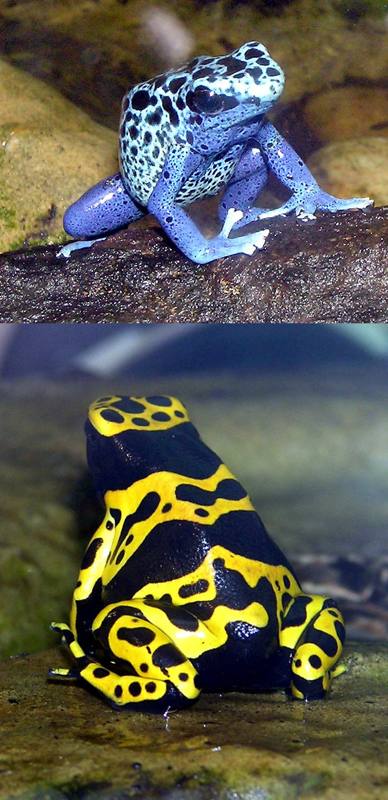
Unlike most frogs, many poison dart frogs are active by day. They do not need to hide, because predators learn their bright colors mean danger. This kind of warning coloration is called aposematism, and it is the opposite of camouflage. Read more in camouflage and warning colors.
Their parenting is remarkable. In many species, eggs are laid on land in moist leaf litter. When the tadpoles hatch, a parent (the male or female, depending on species) lets them wriggle onto its back and carries them to water. Some species deposit each tadpole in a separate tiny pool, such as water trapped in a bromeliad plant. In strawberry poison frogs, the mother returns to each pool to lay unfertilized eggs for her tadpole to eat.
Where the poison comes from
Poison dart frogs do not make their toxins from scratch. They take up alkaloid chemicals from the ants, mites and other small invertebrates they eat, then store and sometimes modify them in skin glands. This is why frogs raised in captivity on fruit flies and crickets are usually not toxic.
The golden poison frog of Colombia is considered one of the most toxic animals known. Its skin carries batrachotoxin, which interferes with nerves and muscles. The common name comes from Indigenous Emberá hunters in western Colombia, who traditionally wiped blowgun darts on the backs of a few species of Phyllobates frogs. Only a few of the 200-plus species have been used this way.
Surprising facts
- One species, the dyeing poison frog, can have dozens of different color forms across its range.
- The bright blue "blue poison frog" is a color form of the dyeing poison frog.
- Some non-toxic frogs mimic the colors of toxic species to fool predators, a strategy called Batesian mimicry.
- Medical researchers have studied frog alkaloids for their effects on nerves and pain.
Threats and conservation
Poison dart frogs are threatened by deforestation, the illegal collection of wild frogs for the pet trade, and the disease chytridiomycosis, caused by the chytrid fungus, which has devastated amphibians worldwide. Captive breeding of popular species has reduced pressure on some wild populations, and several countries now protect key forest sites.
If you keep frogs, buy only captive-bred animals from reputable breeders, and never release pets into the wild, where they can spread disease.
Amphibians are among the most threatened animal groups on Earth. See how to help wildlife for practical actions.