Animal Guides / Reptiles and amphibians
Komodo dragon
The largest living lizard, a 3-meter predator found on only a few Indonesian islands. Learn how it hunts, what its venom does and why it is Endangered.
Quick facts
| Fact | Detail |
|---|---|
| Scientific name | Varanus komodoensis |
| Class | Reptilia (reptiles) |
| Diet | Carnivore: deer, wild pigs, water buffalo, carrion; young eat insects, lizards and birds |
| Size | Adult males often 2 to 3 m long and around 70 to 90 kg; females smaller |
| Lifespan | Around 30 years in the wild |
| Range | Komodo, Rinca, Flores and a few small nearby islands in Indonesia |
| IUCN status | Endangered |
Habitat
Komodo dragons live in a tiny range in the Lesser Sunda Islands of Indonesia, mostly within Komodo National Park and on the western and northern coasts of Flores. The islands are hot and dry, with open grassland savanna, tropical dry forest and beaches. Dragons dig burrows to shelter from midday heat and cool nights.
Behavior
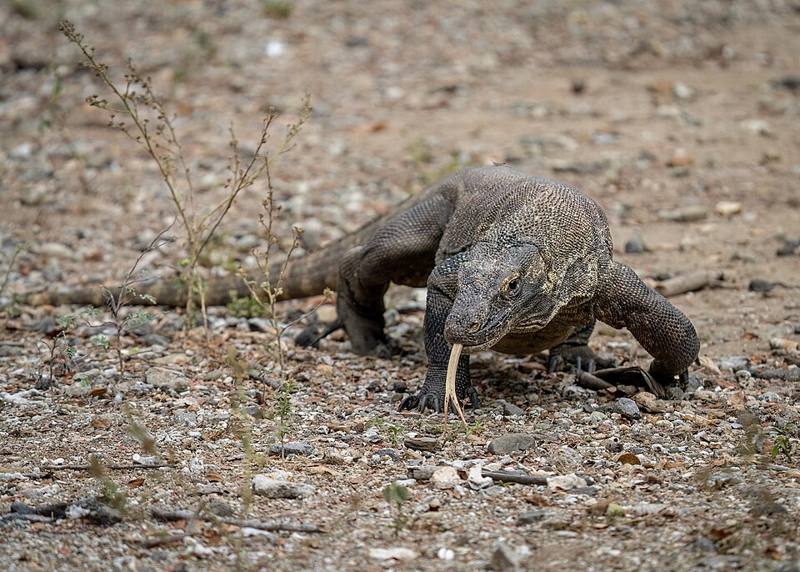
Komodo dragons are ambush predators. An adult waits beside a game trail, then lunges at a passing deer or pig, slashing with serrated, shark-like teeth. Large prey that escapes often dies later, and the dragon follows it using its sense of smell. Like snakes, Komodo dragons flick their forked tongues to collect scent particles and can detect a carcass from several kilometers away.
They can eat up to about 80 percent of their body weight in one meal, swallowing large chunks whole thanks to a flexible jaw and expandable stomach. Then they may go weeks before eating again.
Young dragons spend their first years living in trees, where they are safer from cannibalistic adults. Large adults readily eat smaller dragons.
The venom debate
For years, people believed Komodo dragons killed prey with a mouth full of deadly bacteria. Research published in 2009 found that they have venom glands in the lower jaw that produce proteins which can prevent blood clotting and lower blood pressure. Many scientists now think the combination of deep wounds, blood loss and venom is what weakens prey. The bacteria story has been largely discarded.
Surprising facts
- Female Komodo dragons can reproduce without a male through parthenogenesis. This was documented in zoo animals in the UK in 2006. The offspring from these births are all male.
- Komodo dragons can sprint briefly at around 20 km/h.
- Their armored skin contains tiny bones called osteoderms, a kind of chain mail under the scales.
- Despite the name, they are monitor lizards, related to the much smaller monitors of Africa, Asia and Australia, and distant relatives of snakes.
Threats and conservation
In 2021 the IUCN moved the Komodo dragon from Vulnerable to Endangered. The main reason is climate change: rising sea levels are expected to shrink the low-lying coastal habitat of its small island range considerably in the coming decades. Other threats include loss of prey from poaching of deer and pigs, wildfires, and habitat change on Flores outside the national park. About 70 percent or more of the population lives inside Komodo National Park, which is protected and a UNESCO World Heritage Site.
Komodo dragons occasionally attack people. Visits to Komodo National Park require a ranger guide, and visitors must follow all distance rules.
Compare the Komodo with the largest living reptile in our saltwater crocodile guide.