Animal Guides / Insects and small wonders
Leafcutter ants
These ants do not eat the leaves they carry. They are farmers that grow a fungus garden underground, in colonies that can number in the millions.
Quick facts
| Fact | Detail |
|---|---|
| Group | About 50 species in the genera Atta and Acromyrmex |
| Class | Insecta (insects) |
| Diet | A fungus the ants farm on cut leaves; adults also drink plant sap |
| Size | Workers vary from about 1 mm to 1.5 cm or more, depending on their job; queens are much larger |
| Lifespan | Workers live weeks to months; queens can live 10 to 20 years |
| Range | Tropical and subtropical Americas, from the southern United States to Argentina |
Habitat
Leafcutter ants live in rainforests, dry forests, savannas and farmland across Central and South America, with a few species reaching Texas, Louisiana and Mexico. Atta colonies build huge underground nests with hundreds of chambers connected by tunnels and ventilation shafts. A mature nest can cover many square meters on the surface and reach several meters deep.
How the farm works
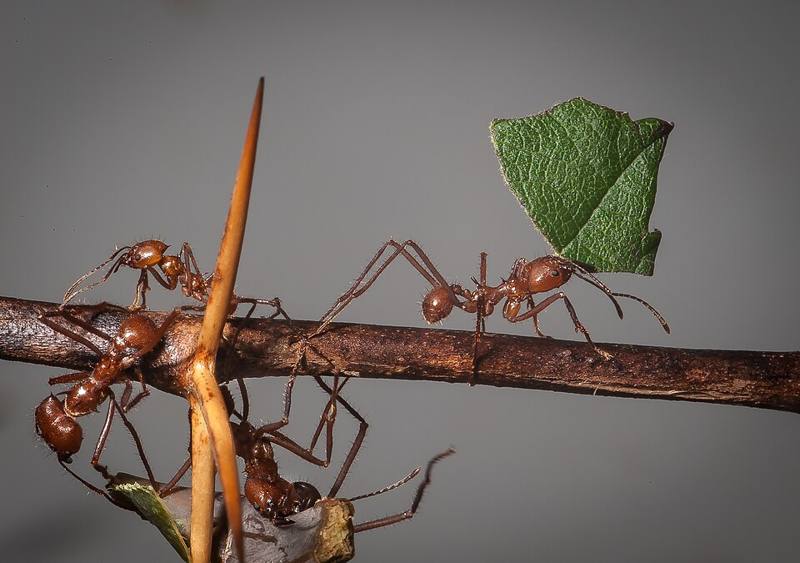
- Harvest: workers climb plants and cut pieces of leaf with their jaws, which vibrate to make clean cuts.
- Transport: they carry the pieces, often many times their own weight, back along cleared trails that can stretch for hundreds of meters.
- Processing: inside, smaller workers clean the leaves, chew them into a pulp and add their own droppings as fertilizer.
- Farming: the pulp feeds a fungus garden. The fungus grows special swollen tips, rich in nutrients, that the ants and their larvae eat.
- Pest control: many leafcutters carry bacteria on their bodies that produce antibiotics, helping control a parasitic mold that attacks the gardens. Workers also weed out infected fungus and carry waste to special dump chambers.
The relationship between leafcutters and their fungus is ancient. The fungus cannot live without the ants, and the ants cannot live without the fungus. Scientists call this mutualism.
A caste system
Leafcutter colonies have one of the most complex divisions of labor in the insect world. Workers come in different sizes suited to different tasks:
| Worker type | Main job |
|---|---|
| Minims (smallest) | Tend the fungus garden and care for larvae; some ride on leaves to guard carriers from parasitic flies |
| Mediae | Cut and carry leaves |
| Majors (soldiers) | Large heads and jaws; defend the nest and clear trails |
A founding queen takes a piece of fungus from her birth colony in a pocket in her mouth, starts a new garden alone and lays the eggs that become the first workers. She mates only during her early flight, then stores enough sperm to produce millions of offspring over her life.
Surprising facts
- A single large Atta colony can contain several million workers.
- Leafcutter ants are major plant consumers in tropical forests, comparable to large grazing mammals in some habitats.
- Trails are marked with chemical scents called pheromones. Read about chemical signals in animal communication.
- People in some regions eat roasted leafcutter queens as a seasonal snack.
Leafcutters and people
Leafcutters can strip crops and garden plants overnight, so farmers in parts of Latin America consider them serious pests. In natural forests, though, they are important ecosystem engineers: their nests mix and aerate soil and move nutrients, creating hotspots of plant growth.
Humans began farming about 12,000 years ago. Fungus-farming ants started tens of millions of years earlier.