Animal Guides / Insects and small wonders
Dragonflies
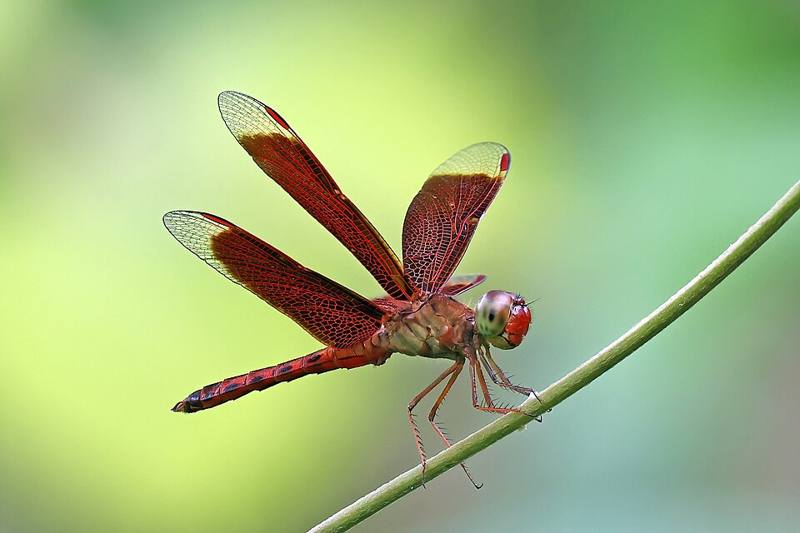
Ancient aerial hunters with nearly all-around vision and some of the highest catch rates of any predator. Most of their life is spent underwater.
Quick facts
| Fact | Detail |
|---|---|
| Group | Order Odonata (dragonflies and damselflies), roughly 3,000 dragonfly species |
| Class | Insecta (insects) |
| Diet | Carnivore: mosquitoes, midges, flies, other flying insects; nymphs eat aquatic insects, tadpoles and small fish |
| Size | Wingspans from about 2 cm to around 15 to 19 cm in the largest species |
| Lifespan | Months to several years as a nymph; usually weeks to a few months as a flying adult |
| Range | Every continent except Antarctica, wherever there is fresh water |
Habitat
Dragonflies need fresh water to breed: ponds, lakes, marshes, slow rivers and streams. Adults hunt over water and nearby meadows, forest edges and gardens. Because nymphs are sensitive to pollution, a rich variety of dragonflies is often a sign of a healthy wetland.
Life cycle
| Stage | What happens |
|---|---|
| Egg | Laid in water, on plants or in mud |
| Nymph (larva) | Lives underwater for months to years, molting many times while hunting |
| Emergence | The nymph climbs a stem, its skin splits and the adult pulls itself out, pumping fluid into its wings |
| Adult | Hunts, mates and lays eggs, usually for a few weeks |
Nymphs are fierce predators too. They have a hinged lower lip, called a mask, that shoots out to grab prey. They breathe through gills inside the rear of the body and can squirt water out to jet forward.
A perfect flying predator
- Eyes: huge compound eyes made of up to tens of thousands of tiny lenses give an almost all-around view and excellent motion detection.
- Wings: four wings that can move independently, letting dragonflies hover, fly backward, turn sharply and change direction in midair.
- Interception: dragonflies do not just chase prey. They predict where it is going and fly to intercept it, like a skilled outfielder catching a ball. Studies of some species have recorded success rates above 90 percent.
- Basket of legs: the legs form a basket to scoop prey out of the air.
Surprising facts
- Dragonfly ancestors called griffinflies lived about 300 million years ago and had wingspans of around 70 cm, larger than any insect today. Higher oxygen levels in the air at that time may have allowed giant insect sizes.
- The globe skimmer, also called the wandering glider, is thought to make one of the longest migrations of any insect, crossing the Indian Ocean between India and East Africa over several generations. Read more in animal migration.
- Dragonflies cannot sting or bite people in any dangerous way.
- Dragonflies rest with wings held flat and open; most damselflies fold their wings along the body. That is the quickest way to tell them apart.
Dragonflies vs damselflies
| Feature | Dragonfly | Damselfly |
|---|---|---|
| Wings at rest | Held out flat | Usually folded together over the back |
| Eyes | Large, often touching | Separated, on each side of the head |
| Body | Stocky | Slender |
| Flight | Fast and powerful | Slower and fluttery |
Conservation
Many dragonflies are common, but species tied to particular wetlands decline when ponds are drained, filled or polluted. A garden pond without fish and with plants that rise above the water is one of the quickest ways to attract them. See how to help wildlife.